Chess Analysis Depth: What We Measured, and Why We Changed Our Minimum
By Joshua Seiler
Chess analysis depth is how many moves ahead the engine searched before judging your game, and most analysis tools never show it. Our first study made depth 20 our minimum. A second study, in October 2026, changed the answer: the engine's network matters more than its depth. This post shows both sets of measurements and what we run now.
What changed in October 2026 when we tested the full network?
The August study below used the lighter Stockfish 18 build, the one that fits in a browser. One of our own games sent us back to the lab: Chess.com called a move a blunder, we called it a mistake, and the difference was the network, not the depth. The full-size network saw the loss at the same depth and node budget where the lighter build did not.
So we measured it: thirty of the founder's rapid games, 1,837 graded moves, run through our pipeline on several engine profiles, every disagreement judged by a full-network search to depth 30. Times: one engine process.
| Engine profile | Moves under-labelled (an error missed or graded too low) | Time per game vs today |
|---|---|---|
| Lighter network, depth 20 (what shipped) | 6.0% | 1.0× |
| Lighter network, depth 22 | 5.3% | 2.5× |
| Lighter network, depth 24 | 5.2% | 4.4× |
| Full network, depth 18 | 4.6% | 0.27× |
| Full network, depth 20 | 4.4% | 0.68× |
| Full network, depth 24 | 3.3% | 2.5× |
Two things stood out. Raising the lighter engine's depth bought almost nothing: every step to depth 24 still missed more errors than the full network at depth 18, at a quarter of the compute. Raising the node budget without raising depth changed nothing, confirming that depth, not budget, moves verdicts.
So, as of October 2026, game review runs on our analysis server with the full-size Stockfish 18 network at depth 18: the same 8-million-node ceiling, two lines searched, both players, every game. It is too large for a phone, so it lives on a server. Turn Fast analysis off in Settings and your games are graded in your browser with the lighter build at depth 20. The two are not identical: the server engine catches more. We also refitted the blunder line against the depth-30 referee, from 20 to 19.25 winning-chance points lost.
We are still improving the system; the next test, full network at depth 20 on the server, will be published the same way.
Why does analysis depth decide whether your mistakes get caught?
Because an engine verdict is only as good as the search behind it, and a shallow search hasn't seen the refutation yet. A queen hung in one move shows up at any depth; the mistakes that actually decide club games, the missed win three moves deep, the "safe" move with a tactical hole, only register once the search reaches far enough to prove them. Stop the search early and the engine doesn't report a rougher version of the truth; it reports a different verdict. A concrete example from our own measurements below: one queen move in the benchmark set is graded "best" at depths 14 through 16 and "mistake" at depth 20, same position, same engine, opposite advice. How evaluations themselves work is covered in the eval bar explainer; this post is about how deep the search behind them should go before you trust a move label built on it.
What did our depth experiments actually find?
Two experiments, run in July 2026, disclosed corpus and all. Neither is a claim about chess truth, the reference in each case is a much deeper engine search, which is the strongest referee available.
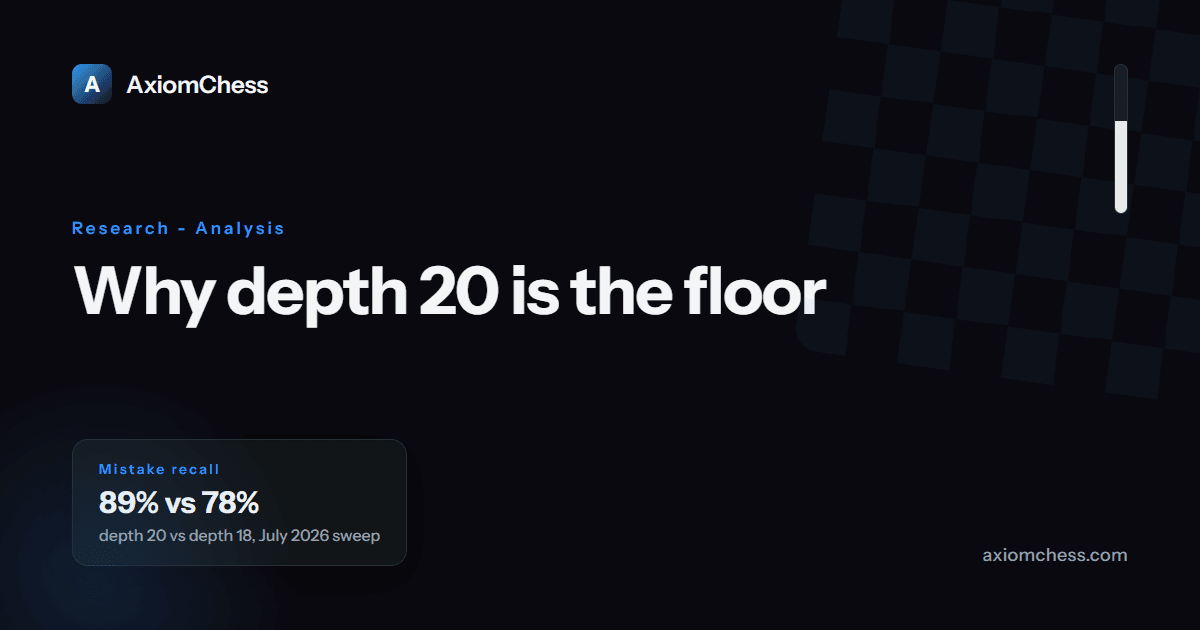
The depth sweep. We analyzed six of my own hardest rapid games, 442 graded moves, deliberately the sharpest games in the set, because easy positions hide depth differences, at every fixed depth from 14 to 24, and scored each depth's mistake calls against a 16-million-node reference search. Depths 20, 22, and 24 all caught roughly 89% of the reference's mistakes. At depth 18 that recall collapsed to about 78% and stayed there at 16 and 14. Depth 14 was around 28× faster than the depth-24 pass, and missed roughly one mistake in five that the reference found. The trade is real in both directions: shallow is enormously cheaper, and it pays for the speed with your worst moves.
The early-stop study. On a frozen 601-move benchmark corpus we recorded what the verdict would have been if the same search had stopped early. Stopped at depth 18, nearly one move in five (18.3%) ends up with a different label than the final depth-20 verdict, and the churn is not cosmetic: it includes mistake↔blunder and inaccuracy↔mistake flips, and 18 missed-win calls that flip per 601 moves. At depth 14 the disagreement grows to almost one in four. This is why we also refuse to show provisional move labels while the search is still running: a verdict that changes 18% of the time is not a verdict.
Small corpus, one player's games, engine referee, all disclosed. But the shape of the curve was unambiguous, and for the lighter engine it still holds: the cliff sits directly below depth 20. What the October test added is that the full network sits above that cliff two depths earlier.
Why not just analyze at depth 24 or higher?
Because above 20 we measured diminishing returns, and paid 2.5× the time for them. In the same sweep, depth 24 caught about 89.9% of the reference's mistakes against roughly 89% at depth 20, a difference inside the noise on this corpus, while taking two and a half times as long in our harness. Interestingly, Chess.com's own engineering documentation says the same thing: "Our research has found diminishing returns in engine quality as depth gets past the low 20's." We agree, the low 20s are exactly where the curve flattens. Deeper profiles are a calibration decision we revisit as engine speed improves, not a free accuracy win.
One honesty note that belongs in any depth claim: our pass is bounded. Every graded position gets Stockfish 18 searching to its profile's depth (18 with the full network on our server, 20 with the lighter build in your browser) under an 8-million-node ceiling, and in rare pathological positions the ceiling stops the search first. When that happens we store the depth actually reached with the analysis instead of pretending. A depth number without that disclosure is marketing, not measurement.
What depth do other chess platforms actually run?
Only claims we could verify, checked in August 2026, and they are three very different answers.
Chessigma runs a fixed depth 14. Their own technical blog post says it plainly: "For most moves we stop at depth 14 a practical balance between insight and waiting time…" The constants shipped in their live client code say the same thing (DESKTOP_DEPTH:14, MOBILE_DEPTH:14). That is a legitimate, deliberately chosen speed trade-off, their analysis is very fast, but per our sweep, depth 14 sits well below the mistake-detection cliff. The "depth 50" their marketing mentions applies to opening positions served from a cached book, not to searching your actual middlegame.
Lichess publishes its budget: one million nodes per move, for everyone. Server analysis runs Stockfish 18 with a fixed budget of 1,000,000 nodes per move, the constant is right there in their open-source server code, and it is identical for free accounts and Patrons. A node budget means the reached depth varies by position rather than being fixed. That transparency is exactly what we think an analysis tool owes its users, which is why our own budget, full network at depth 18 on the server or the lighter build at depth 20 in your browser, 8-million-node ceiling, both players, every game, appears in our analysis and in posts like the game review explainer.
Chess.com does not publish a number. Its Game Review runs Stockfish 18 with full NNUE server-side, but none of its official documentation states the depth, nodes, or time it searches per move, and a staff moderator has said the review is node-limited rather than depth-limited, so no current depth figure exists to cite. Historically the free tier was shallower: in a 2021 thread, users observed the free plan's first daily review running at depth 18, and staff confirmed follow-up analyses ran at depth 10. Whatever the current budget is, we chose not to compete on undisclosed numbers: if a verdict on your game depends on how hard the engine looked, you should be able to see how hard it looked.
How did we catch our own site running too shallow?
The depth-20 floor isn't a slogan for us, it once cost us a fix on our own site. In July 2026, while auditing analysis speed, we discovered our deployed build was requesting depth 18: an older build's default, live in production, sitting exactly on the wrong side of our own measured cliff. By the sweep's numbers, that build was missing roughly one mistake in five relative to the reference. We ratified the depth-20 minimum and shipped it, and because the analysis pipeline was already versioned, every stored game recorded the exact profile that had graded it, which is what made the discrepancy findable at all. When the search changes, your games are re-analyzed under the new version the next time you open them, rather than silently mixing verdicts from different searches.
That incident is the honest case for disclosure. Every tool has a depth; few show it; and as our own slip demonstrates, the number can quietly change underneath you. The only durable protection is a tool that prints its budget and versions its verdicts, whoever you use for finding what your games say about you.
FAQ
Is deeper chess analysis always more accurate?
Up to a point, sharply; past it, barely. With the lighter engine we found large recall gains up to depth 20 and noise from 20 to 24, at 2.5× the cost. In October the network mattered more: the full network at depth 18 caught more than the lighter one at 24. Chess.com's documentation reports the same diminishing returns past the low 20s. Depth also can't fix a bad referee: every accuracy verdict is an engine's opinion, not ground truth.
What depth is enough to catch blunders?
Outright hangs show up at shallow depth, that's not where depth matters. The expensive misses are missed wins and tactically refuted "safe" moves: in our early-stop study, missed-win verdicts flipped at every snapshot depth below 20, and depth 18 still relabeled nearly one move in five. If the analysis only needed to catch hangs, depth 10 would do; grading a whole game honestly is what needs 20.
Why don't most chess sites show their analysis depth?
We can only report what we verified: Lichess publishes its node budget in open-source code, Chessigma states its depth 14 in a blog post, and Chess.com publishes no current figure for Game Review. Our position is that the number belongs next to the verdict, we print ours and store it with every analyzed game, so a verdict can always be traced to the search that produced it.
What is a node ceiling in chess analysis?
A second budget besides depth: the maximum number of positions the engine may examine in one search. Ours is 8 million nodes per move, so a pathological position stops early rather than stalling your analysis, and the analysis records the depth actually reached. Lichess budgets by nodes alone (one million per move), which is why its reached depth varies from position to position.
Depth is one of the numbers your move labels stand on; the network is the other. Analyze your games free. Full-network Stockfish 18 at depth 18 on our server, the lighter build at depth 20 in your browser, 8-million-node ceiling, both players, every game, disclosed.