How to Get Better at Chess: Fix the Thing That's Actually Costing You
By Joshua Seiler
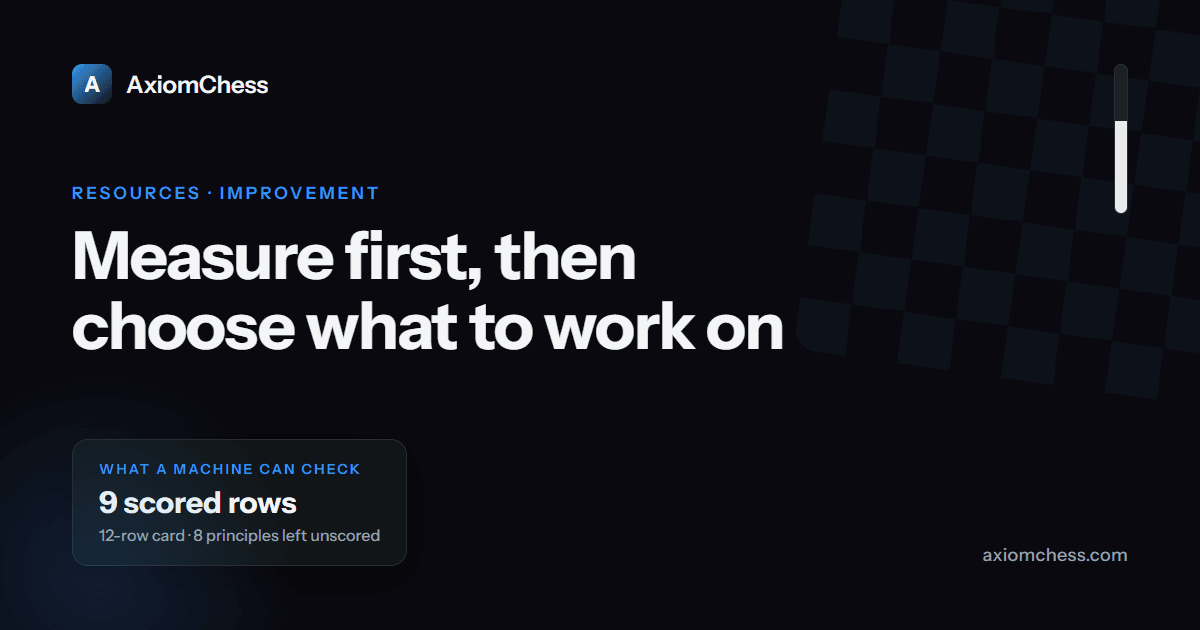
You get better at chess by fixing the specific thing that keeps costing you games, not by studying more of everything. Most improvement advice is generic because it was written without seeing your games. This is a plan built the other way round: measure first, then choose what to work on.
What actually makes you better at chess?
Three things, in a strict order: playing enough long games to generate evidence, finding what repeats in them, and drilling that one thing until it stops repeating. Drilling before diagnosis is how people study for a year and gain nothing.
The reason the order matters is that chess weaknesses are narrow and personal. "Tactics" is not a weakness; hanging a piece when you are winning is. "Endgames" is not a weakness; failing to activate your king in rook endings is. That granularity is the whole design premise of the report card described below, it counts each fundamental separately, per game, so what surfaces is one row you skip rather than a subject you're "bad at." Generic study distributes your effort evenly across a problem that is not evenly distributed, which is why it feels like work and doesn't move your rating.
What chess improvement advice should you ignore?
Ignore anything that prescribes without measuring. The most common examples:
- "Study openings less" and "study openings more." Both are prescriptions issued without seeing whether your games are actually decided in the opening. For most club players they aren't, but that's a claim your own game record can settle in ten minutes.
- "Do 100 puzzles a day." Volume without targeting trains the patterns you already see. Puzzles work when they're matched to the mistakes you actually make, which is why AxiomChess selects them from your weakest report-card rows rather than serving a generic queue.
- "Just play more." Playing generates evidence; it doesn't interpret it. Games without review are repetitions of the same habits, which is the mechanism behind most plateaus, covered in depth in why you're not improving at chess.
- "Analyze with an engine after every game." Closer, but engine-first review turns you into a spectator of your own game. The game review explainer covers the order that works: your story first, engine second.
What can a machine actually check in your games?
Less than most chess apps imply, and the boundary is worth knowing, because it tells you which parts of improvement you can outsource to a tool and which you can't.
Start with what a machine refuses to grade. Eight principles in the AxiomChess coach, play the thematic break, seize the open file, pressure the half-open file, make luft, trade when ahead, rook behind the passer, push the passer, break to create a passer, are carried as teaching only, and one of them, the thematic break, is currently dormant while its detector is rebuilt. None of the eight is ever scored, because their correctness depends on judgment a board-geometry check can't settle, and scoring them would manufacture confident numbers out of guesses.
What does get scored is a fixed report card of twelve rows. Nine are fundamentals with board-readable predicates, the kind of thing a machine can test without guessing at intent:
- Finish development first
- Castle on time
- Meet the threat
- Rooks to open files
- Rook to the seventh
- Knight to an outpost
- Improve your worst piece
- Passed pawns
- Activate the king
The remaining three rows are synthetic, tactics, piece safety, and converting won positions, built from different evidence than the doctrine rows.
The scoring is stricter than the predicates alone. A row only counts a position when the engine's own best move demonstrates that fundamental, forced moves are excluded from the denominator, and positions that were already lost or already won are routed out before anything is graded. Every game gets the same bounded Stockfish 18 pass, depth 18 with the full network on our server (depth 20 with the lighter engine in your browser), an 8-million-node ceiling, both players, so that two games are actually comparable.
That is the honest boundary of automated diagnosis: it is good at telling you which provable habit you skip, and it does not replace a human coach or your own thinking on the rest. Any tool that grades you confidently on all seventeen is telling you something it doesn't know.
How do you turn your own games into a study plan?
Take twenty of your recent long games and find what repeats, one recurring cause, not twenty individual mistakes. The tagging method itself (how many games, how to phrase a cause rather than a move, how many repeats make a leak) is worked through step by step in why you're not improving at chess. What that guide doesn't cover is what to do with the answer, which is where most plans actually fail:
- Pick the drill that matches. Not the drill you enjoy. If your leak is missing opponent threats, that's a blundering problem; if it's losing won games, that's a conversion problem, which has an entirely different fix.
- Re-measure after a month. Same twenty-game count, same cause. If it hasn't moved, the drill was wrong, not you. Improvement you can't measure is indistinguishable from improvement you're imagining.
One constraint on which games you collect: play a time control long enough to have thoughts you can later inspect. Blitz generates games but not evidence, because the mistakes are clock artifacts rather than understanding gaps, the clock-data post shows how to tell those apart, which matters because time-trouble mistakes will corrupt your diagnosis if you count them as knowledge gaps.
If you'd rather not tally by hand, that's exactly what the report card automates, and weakness-matched puzzles come from a bank of about 14,000 positions sourced from the Lichess open puzzle database, which is released under CC0, real positions from real games, invariant-checked, never hand-written to prove a point. Bring your games in and the counting happens for you.
Whichever tool you use, the criteria that matter are in the analysis app comparison, and where you play barely matters, the platform comparison covers that. Don't judge progress by accuracy percentage, for reasons the accuracy post explains.
FAQ
How many hours a week do you need to improve at chess?
Fewer than most people assume, spent differently. Four to six focused hours, three long games, an hour reviewing them properly, and an hour drilling one identified weakness, outperforms fifteen hours of blitz and unfocused puzzles. Consistency over months beats intensity over weeks, because the measurement loop needs repetitions to show whether anything changed.
Is playing or studying more important for chess improvement?
Neither alone works. Playing generates the evidence; studying without evidence targets the wrong thing. If forced to choose, play long games and review them, that combination contains a study loop inside it. Pure study without games has nothing to correct itself against.
Can adults still get good at chess?
Yes, with a caveat I'd offer as opinion rather than fact: adults make real, repeatable gains at club level, while master-level results for players starting late are rare enough that I wouldn't plan a training programme around them. Adult improvers also have an advantage, they can actually run a measurement loop on themselves.
What is the fastest way to gain chess rating?
Stop losing games you're already winning. My strong impression from reviewing club games is that blunders and botched conversions cost more rating than opening preparation ever gains back, though that's exactly the sort of claim you should settle against your own record rather than take from me. Both respond quickly once named: conversion and blundering each have their own fix.
Chess improvement isn't mysterious, it's just usually unmeasured. Get twenty games in front of something that counts, and the next month plans itself. Analyze your games free, one bounded Stockfish 18 pass over both sides of every game you bring, and a ranked list of the fundamentals you actually skip.