How to Learn Chess Openings: Fewer Lines, Learned for Keeps
By Joshua Seiler
Learning chess openings is a memory problem before it is a chess problem: choose a small set of sound lines, learn each move with the idea attached, and review every line on a spaced schedule until recall is automatic. What most club players lack is not opening knowledge, it is a system that keeps the knowledge from evaporating.
How many opening lines do you actually need?
Far fewer than the courses suggest. A working first repertoire is one answer to 1.e4, one answer to 1.d4, and one setup you trust as White, a handful of main lines plus the two or three replies you actually meet at club level. Club games typically leave known theory early, often within the first ten moves, so the marginal value of a fifteenth line is close to zero while the first five are still shaky. The study catalog in AxiomChess is built on the same bet: 269 lines across 70 openings, each about ten moves deep, rather than an encyclopedia, because a catalog you can actually keep reviewed beats one you can only browse (and the daily review cap keeps even that honest).
The failure mode this protects you from is breadth-without-recall: twenty half-remembered systems lose to three automatic ones, because a half-remembered line collapses at the first move you cannot retrieve, usually with your clock running. Choose lines you can commit to reviewing, not lines that impress you in a video.
Should you learn opening moves or opening ideas?
Both, in that order for each line: the move first, then the reason the move exists, the pawn break the line is aiming for, the piece that would otherwise be bad, the trap the move order avoids. Ideas are not a substitute for knowing the moves; they are what makes the moves retrievable. A move with a reason attached survives in memory; a bare move sequence decays into "something with the bishop." This is why guided learning in AxiomChess teaches each line move by move with its reason attached before you ever drill the sequence cold, every line carries authored notes on what it is for, and a growing set of lines (the full Sicilian family first) adds an authored move-by-move plan walkthrough on the board.
Ideas also cover you when the opponent deviates, which at club level is most games. If you know why your line plays a move, you can usually punish the move your opponent played instead of it, or at least reach a normal position. If you only know the sequence, an early deviation leaves you out of book and out of ideas simultaneously.
Deviations are also more predictable than they feel, because what opponents actually play against a line changes sharply with level. The trainer shows replies bucketed by opponent rating for exactly this reason: the sideline that dominates under-1200 games has often vanished from 1800 games, and preparing for the field you actually meet beats preparing for the engine's main line.
How do you memorize chess openings so they stick?
With spaced review, not with cramming. The memory research here is one of the oldest solid results in psychology: reviews spread out in time produce far more durable recall than the same number of reviews massed together (Cepeda et al., 2006, a quantitative synthesis of 317 spacing experiments). Openings are exactly the kind of material the effect applies to, sequences you need cold months from now, not just tonight.
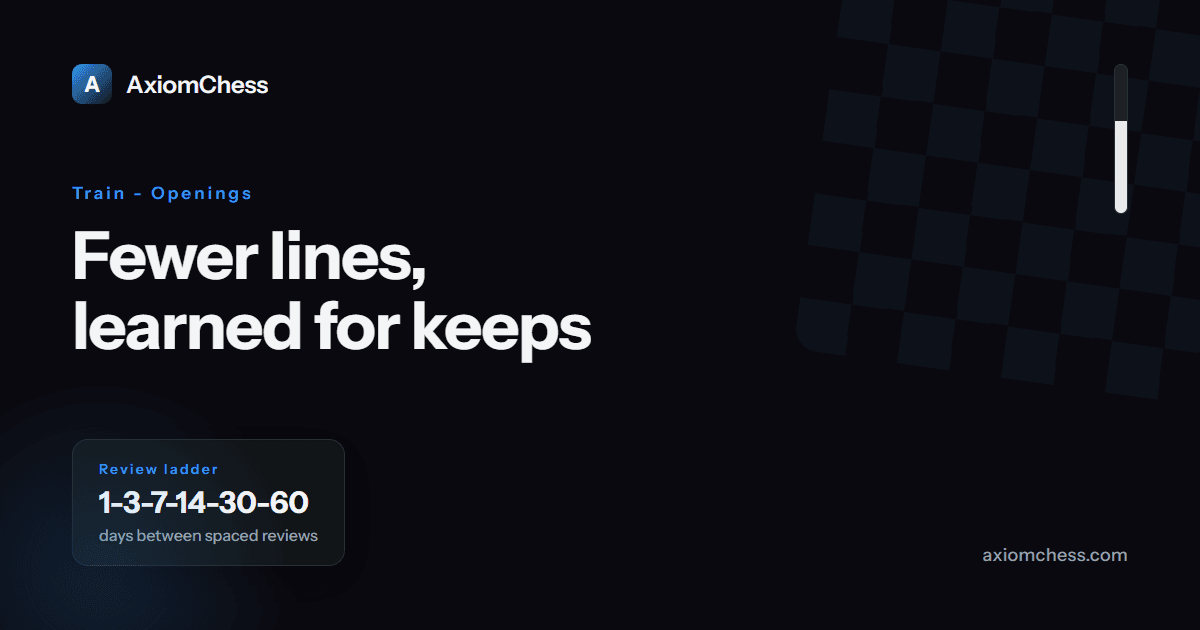
The opening trainer in AxiomChess implements this as a deliberately simple Leitner ladder rather than a black-box algorithm. Every line you drill sits in one of six boxes, reviewed after 1, 3, 7, 14, 30, and 60 days: a spotless run promotes the line one box, a rough run (a wrong move or two) holds it in place, and a failed run demotes it two. One grading rule does the most work: revealing the answer always fails the run, being shown the move is not recall, and a schedule built on recognition instead of recall drifts toward comfortable self-deception. You can replicate the same ladder with physical flashcards or any SRS tool; the mechanism matters more than the software.
Two rules joined the learn flow after watching players, myself included, try to game it. A branch line replays its shared trunk from memory first, so recall of the stem is re-tested every time a new deviation is taught and a branch strengthens the line it grows from instead of bypassing it. And practice is gated behind the recall step: you run the line from memory at least once before you drill it against replies, because drilling a line you have never retrieved is just rehearsed guessing.
How deep should you learn an opening line?
To the point where theory ends and a plan begins, for club purposes, roughly ten moves. Past that depth you are memorizing positions your opponents will never reach, and every extra ply added to a line makes the whole line harder to retain. Depth should also be verified, not inherited: lines repeated for decades can conceal moves an engine refutes in seconds. The study lines shipped in AxiomChess are sourced from master practice and every move is checked against Stockfish before it is taught, precisely because "everyone plays this" and "this is sound" are different claims.
A useful discipline at the end of any line you learn: stop and name the plan, which pawn break, which piece goes where, what the opponent wants. If you cannot, the line is too deep for you right now, and the shallower version with a plan attached will score better.
How do you find where your openings go wrong in real games?
Measure, don't guess. The openings you think you misplay and the positions where you actually shed winning chances are routinely different, and the only way to see the difference is to compare your games against the lines you claim to know. This is tedious by hand, which is why almost nobody does it, and it is the part AxiomChess automates, with two deliberately different matchers: a line is credited to "your games" only when a game actually followed its opening moves, a count that can miss transpositions but never inflate, while slip spots are matched by exact position, which catches the transpositions a move-order count cannot see. The trainer then surfaces the study line that passes through your most-repeated measured slip, with a one-click drill of that line.
Once a slip spot is fixed by drilling, the right system goes quiet about it until the review falls due, instead of nagging you about a mistake you already corrected. What you should not do is study whichever opening annoyed you most recently: one bad game against a gambit is an anecdote. A recurring eval drop at the same position across several games is a pattern worth a week of drills. The weakness-finding method is the same for openings as for everything else: patterns, not accidents.
FAQ
How long does it take to memorize an opening line?
Less time than most players spend, spread over more days. A ten-move line needs only a few focused drills, but spaced across weeks, not stacked in one evening. On a Leitner schedule, a line you keep drilling cleanly is reviewed at growing intervals until maintenance costs a minute or two a month. The calendar does the work; your job is showing up when a review is due.
Do openings matter at club level?
For most club players, less than tactics and far less than blunder rate, which is why opening study should be a slice of your training, not the whole of it. Whether opening study can fix a stuck rating is a different question, the plateau post covers why improvement stalls and where openings fit in that diagnosis.
Is it better to learn many openings or a few?
A few, learned to automaticity. Every additional system multiplies your review load and dilutes your experience in the structures you play. Depth of familiarity, knowing the typical middlegame plans of three openings, beats surface acquaintance with ten. Add a new opening when your current lines feel automatic and their reviews are cheap, not when a novelty looks exciting.
Can you learn openings just by playing?
Playing teaches you move-order habits, but it cannot tell you which of those habits are mistakes, an unexamined deviation just becomes muscle memory. Games are where openings are tested, not where they are learned: reviewing those games afterwards is what converts them into study material, as covered in how to review a game.
Your games already know which openings you actually play and where they go wrong. Analyze your games free and the report card will show you which lines deserve the drills.